


Nieuws
Let op: de inhoud van de berichten is correct op het moment van publicatie, maar kan zonder voorafgaande kennisgeving worden gewijzigd. Deze pagina toont alleen de meest recente items. Klik voor het volledige archief van persberichten op ‘Zoeken op categorie of jaar’.
Mitsubishi Electric’s New Plate Heat Exchanger Delivers 3x Conventional Heat Transfer Performance
 PDF Version (PDF:464.5 KB)
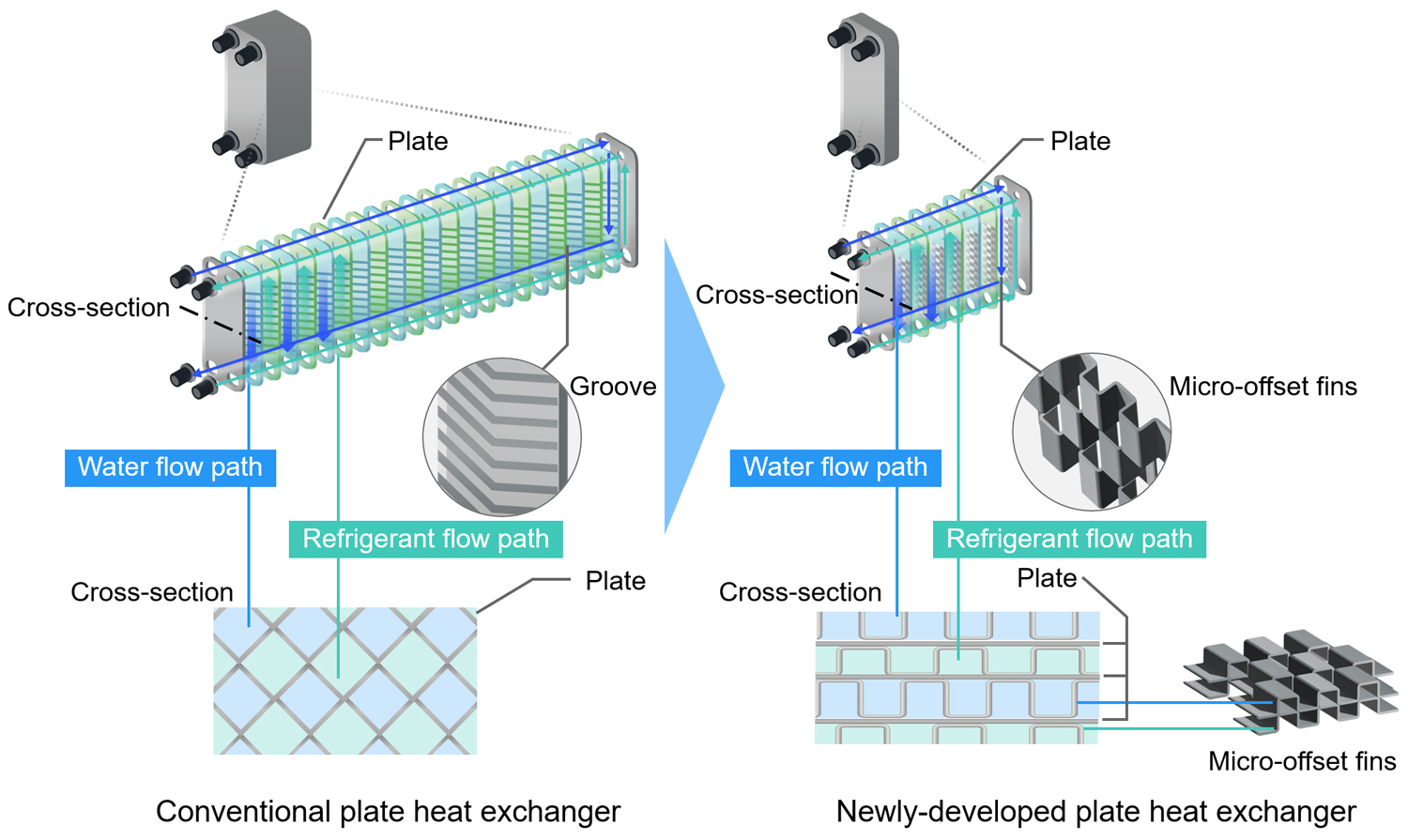
Comparison of plate heat exchanger structures
TOKYO, September 14, 2026 – Mitsubishi Electric Corporation (TOKYO: 6503) announced today that it has developed a plate heat exchanger for heat pump1 cooling and heating equipment with industry-leading2 heat transfer performance – triple3 that of conventional models. Specifically, the new heat exchanger reduces the number of plate layers allowing the refrigerant charge to be reduced to approximately one-third that of conventional levels, resulting in lower environmental impact and improved safety.
The urgent need to achieve carbon neutrality has led to stricter refrigerant regulations, requiring a shift to next-generation refrigerants and a reduction in the refrigerant charge in heat pump cooling and heating equipment. While next-generation refrigerants like R32 have a lower Global Warming Potential (GWP), many are flammable, making it essential to minimize their volume to reduce the danger of accidental leaks. Although increasing heat transfer performance reduces the refrigerant charge, conventional heat exchangers with grooved plates perform insufficiently. Inserting micro-offset fins4 between the flat plates was considered to promote heat transfer, but tests confirmed that the refrigerant’s gas-liquid two-phase flow does not distribute uniformly across an entire plate.
Mitsubishi Electric’s new plate heat exchanger has distribution channels at the fluid inlets and outlets that ensure uniform refrigerant flow across plates, even those fitted with micro-offset fins. The result is an even distribution of gas-liquid two-phase flow refrigerant. Channel placement was optimized using proprietary analysis technology that simulates the complex flow of two-phase refrigerants between fine fins. As a result, Mitsubishi Electric has achieved industry-leading heat transfer performance, approximately three times that of conventional heat pump-type cooling and heating equipment.
This technology can be applied to a wide range of products, including water-based cooling and heating equipment, heat pump systems for electric vehicles (EVs) and air-cooled air conditioners. Mitsubishi Electric plans to incorporate this new technology into its diverse product lineup to contribute to global efforts to achieve carbon neutrality.
- 1
A system that transfers heat from the environment (air, water, etc.) for heating or cooling.
- 2
As of September 14, 2026, according to Mitsubishi Electric’s research on plate heat exchangers for heat pump-type cooling/heating equipment.
- 3
Compared to Mitsubishi Electric’s conventional grooved plate heat exchangers.
- 4
A structure where fine fins are arranged in an offset pattern to promote turbulence and heat transfer.
Inquiry
-
Media contact
-
Customer Inquiries
Advanced Technology R&D Center
Mitsubishi Electric CorporationFax: +81-6-6497-7285